Record Detail
Text
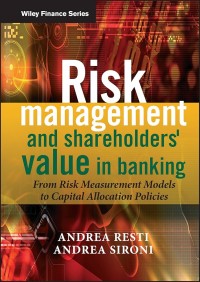
Risk Management and Shareholders' Value in Banking : From Risk Measurement Models to Capital Allocation Policies
- Share to:


Risk Management and Shareholders’ Value in Banking is quite simply the best written and most comprehensive modern book that combines all of the major risk areas that impact bank performance. The authors, Andrea Resti and Andrea Sironi of Bocconi University in Milan are well known internationally for their commitment to and knowledge of risk management and its application to financial institutions. Personally, I have observed their maturation into world class researchers, teachers and consultants since I first met Sironi in 1992 (when he was a visiting scholar at the NYU Salomon Center) and Resti (when, a few years later, he was on the same program as I at the Italian Financial Institution Deposit Insurance Organization (FITD)). This book is both rigorous and easily understandable and will be attractive to scholars and practitioners alike.
It is interesting to note that the authors’ knowledge of risk management paralleled the transformation of the Italian Banking System from a relatively parochial and unsophis- ticated system, based on relationship banking and cultural norms, to one that rivals the most sophisticated in the world today based on modern value at risk (VaR) principles. In a sense, the authors and their surroundings grew-up together.
Perhaps the major motivations to the modern treatment of risk management in banking were the regulatory efforts of the BIS in the mid-to-late 1990’s – first with respect to market risk in 1995 and then dealing with credit risk, and to a lesser extent operational risk, in 1999 with the presentation of the initial version of Basel II. These three elements of risk management in banking form the core of the book’s focus. But, perhaps the greatest contribution of the book is the discussion of the interactions of these elements and how they should impact capital allocation decisions of financial institutions. As such, the book attempts to fit its subject matter into a modern corporation finance framework – namely the maximization of shareholder wealth.
Not surprisingly, my favorite part of the book is the treatment of credit risk and my favorite chapter is the one on “Portfolio Models” within the discussion of “Credit Risk” (Chapter 14 in Part III of the book). As an introduction to these sophisticated, yet con- troversial models, the authors distinguish between expected and unexpected loss – both in their relationships to estimation procedures and to their relevance to equity valuation, i.e., the concept of economic capital in the case of unexpected loss. While there are many structures discussed to tackle the portfolio problem, it is ironic that despite its impor- tance, the Basel Committee, in its Basel II guidelines, does not permit banks to adjust their regulatory capital based on this seemingly intuitively logical concept. Perhaps the major conceptual reason is that the metric for measuring correlations between credit risks of different assets in the portfolio is still approached by different theories and measures. Is it the co-movement of firm’s equity values which presumably subsumes both macro and industry factors as well as individual factors, or is it the default risk correlation as measured by the bimodal or continuous credit migration result at the appropriate horizon. Or, is it simply the result of a simulation of all of these factors.
While the use of market equity values is simply impossible in many countries and for the vast majority of non-publicly traded companies worldwide, perhaps the major impediment is the difficulty in back-testing these models (as the authors point out) and the fact that banks simply do not make decisions on individual investments based on portfolio guidelines (except in the most general way and by exception, e.g., industry or geographical limits). In any event, the portfolio management of the banks’ credit policies remains a fertile area for research.
It is understandable, yet still a bit frustrating, that the operations risk area only receives minor treatment in this book (two chapters). The paradox is that we simply do not know a great deal about this area, at least not in a modern, measurable and modelable way, yet operational problems, particularly human decisions or failures, are probably the leading causes of bank failure crises, and will continue to be. In summary, I really enjoyed this book and I believe it is the most comprehensive and instructive risk management book available today.
Availability
| E000826 | 332.1068 RES r | Perpustakaan IBS (ebook) | Available |
Detail Information
| Series Title |
-
|
|---|---|
| Call Number |
332.1068 RES r
|
| Publisher | John Wiley & Sons, Inc : Chichester, West Sussex PO19., 2007 |
| Collation |
-
|
| Language |
English
|
| ISBN/ISSN |
9780470029787
|
| Classification |
332.1068
|
| Content Type |
text
|
| Media Type |
computer
|
| Carrier Type |
online resource
|
| Edition |
1st
|
| Subject(s) | |
| Specific Detail Info |
-
|
| Statement of Responsibility |
Sironi, Andrea
|
Other version/related
No other version available